
Commercial Off Grid Solar and Microgrid Systems
Maktinta designs off grid solar and microgrid systems for facilities that need reliable power beyond what the utility grid alone can provide.
Our systems integrate solar PV, battery storage, generators, controls, monitoring, and load management around the actual electrical demand, required runtime, outage tolerance, and operating conditions of the site.

Commercial Off Grid and Microgrid Applications
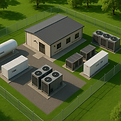
Remote Facilities
Energy systems for sites where utility service is unavailable, unreliable, or prohibitively expensive to extend.

Municipal and Emergency Infrastructure
Resilient power systems for facilities that need to maintain essential operations when the utility grid is unavailable.

Commercial and Industrial Sites
Grid connected microgrids designed to improve resilience, manage demand, and support critical operations during utility interruptions.

Resorts and Lodges
Off grid and hybrid energy systems for remote hospitality properties with significant electrical loads and limited utility infrastructure.

Agricultural Operations
Solar, battery, and generator systems for remote pumps, processing equipment, buildings, and other agricultural loads.

Mission Critical Facilities
Microgrid systems designed around critical loads, outage duration, redundancy requirements, and the operational cost of losing power.

Off Grid and Microgrid Are Not the Same Thing
A true off grid system operates without a utility connection and must generate, store, and manage enough energy to support the required loads on its own.
A microgrid can remain connected to the utility during normal operation and disconnect, or island, when grid power is unavailable.
Both architectures may use solar, battery storage, generators, and advanced controls, but the required equipment and system sizing depend heavily on how independent the facility needs to be.
Maktinta determines that architecture before equipment is selected.
Resilience Starts With the Load
Battery capacity and solar array size should not be selected from a generic backup target. Maktinta starts by identifying which loads are critical, how much power they require, how long they must operate without the grid, and how those loads change throughout the day.
We then evaluate solar production, battery capacity, generator support, site conditions, utility reliability, and acceptable outage risk.
That analysis determines whether the project requires several hours of backup, multi day resilience, or complete off grid operation.
Why Build an Off Grid or Microgrid System?
The value of localized energy is not simply generating electricity onsite. It is gaining greater control over when energy is produced, stored, and used.
Depending on the project, an off grid or microgrid system can improve resilience, reduce exposure to outages, support remote operations, manage peak demand, and reduce dependence on utility power.
-
Maintain critical loads during grid outages
-
Provide power where utility service is unavailable
-
Manage peak electrical demand
-
Increase facility resilience
-
Integrate onsite renewable generation
-
Reduce generator runtime and fuel consumption
-
Create greater visibility and control over facility energy use

Integrated Energy System Design
Battery Energy Storage
Battery storage is sized around actual power demand, required runtime, charging strategy, and allowable depth of discharge rather than a generic capacity target.
Solar PV Generation
Solar generation is modeled against facility loads and battery charging requirements so the array supports the operating strategy of the complete system.
Generator Integration
Diesel, propane, or natural gas generation can provide additional resilience during extended outages or periods when renewable production is insufficient.
Microgrid Controls
Controls coordinate generation, battery state of charge, facility loads, generator operation, and utility interaction so the system responds automatically to changing conditions.
Remote Monitoring
Maktinta can integrate remote diagnostics and system monitoring to track operating conditions and identify problems without requiring constant onsite intervention.
Load Management
Critical and noncritical loads can be prioritized so available energy is directed where it matters most during constrained operating conditions.
One System, Multiple Energy Sources
A resilient energy system must continuously decide where power should come from and where it should go.
During normal operation, solar can serve facility loads and charge the battery while the grid or generator provides additional energy when required. During an outage, the microgrid can disconnect from the utility and use available solar, storage, and generation to support prioritized loads.
In a fully off grid application, that same control strategy operates continuously without relying on utility power.