
How AI Data Centers Are Redefining Data Center Energy Efficiency

At a recent OCP Summit, Microsoft presented grid power behavior data that perfectly illustrates a growing reality in our industry. The power consumption profile of an AI token factory is fundamentally different from a traditional data center. While traditional compute and storage racks maintain a relatively flat, predictable load, AI workloads operate with violent volatility.
As AI workloads explode, large-scale facilities face power demand that swings dramatically. A 50 MW facility might see rapid shifts of tens of megawatts in milliseconds as GPU clusters move between intense compute phases and lighter communication or idle periods. Once a massive training batch is processed, the system sits idle, waiting for network or memory tasks to catch up before the cycle repeats. The result is a power draw profile that looks like a volatile seismograph.
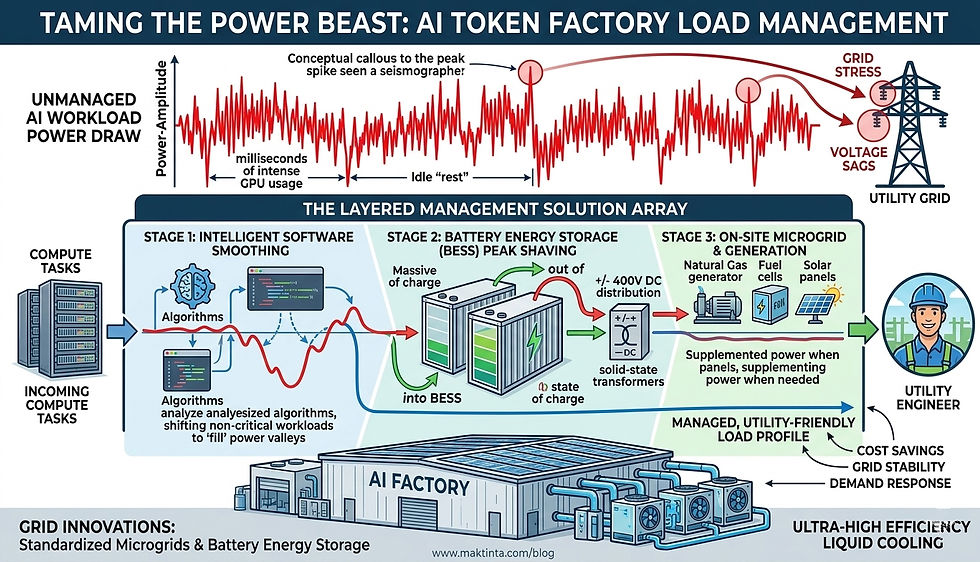
The Grid, Facility, and Data Center Energy Efficiency Impact
The electrical grid relies on inertia, predictability, and balanced loads. When an AI data center suddenly spikes its load by tens of megawatts in a matter of seconds, it creates severe transient events. This rapid ramping can cause localized frequency droop, voltage sags, and massive thermal stress on local substation transformers.
For the facility operator, this variability destroys project economics and strains infrastructure. Utilities levy heavy peak demand charges. If your power spikes wildly for only a few minutes an hour, you are paying a massive premium for that brief peak.
There is also the mechanical reality. A sudden spike in electrical power translates directly into a sudden spike in heat. The facility's high-density cooling architecture must respond instantly to reject millions of BTUs of heat, otherwise the silicon will overheat and throttle down.
How the Industry Is Improving Data Center Energy Efficiency
The industry has developed a sophisticated, multi-layered approach to smooth these fluctuations while still consuming the allocated energy.
1. Intelligent Software and Workload Orchestration
The first line of defense is software. Operators use real-time monitoring to detect power valleys and automatically inject secondary compute tasks to fill them. This helps maintain a more consistent draw without wasting energy. Other key techniques include:
Flexible scheduling: Delaying or shifting non-urgent training jobs to times or locations with better power availability.
Power capping: Dynamically limiting GPU power draw or adjusting voltage and frequency to reduce peaks with minimal performance impact.
Geographic distribution: Spreading workloads across regions and time zones to balance overall demand.
2. Hardware and Firmware Controls
GPU manufacturers are building better controls directly into the silicon. Newer architectures include features for ramp-rate limiting, power floors, and profiled consumption patterns that prevent sudden spikes. Combined with advanced power distribution systems utilizing +/- 400V DC distribution architectures and solid-state transformers, hardware-level solutions make the entire facility more stable at the source.
3. Energy Storage Integration
We cannot rely on the grid to absorb these transients. Batteries have become essential infrastructure for modern AI data centers. During GPU rest periods, the facility draws a steady baseline of power from the grid to charge the batteries. When the workload initiates and power demand spikes, the battery system discharges to cover the delta.
Rack-level storage: Handles ultra-fast transients in milliseconds directly at the hardware level.
Facility-scale storage: Battery Energy Storage Systems provide peak shaving, load smoothing, and backup ride-through.
4. On-Site Generation and Microgrids
Operators are reducing reliance on the grid alone by deploying on-site generation. This includes natural gas or diesel generators paired with batteries, as well as renewable and storage microgrids. Colocating generation with compute load minimizes transmission losses and increases overall resilience.
5. Grid Collaboration and Commercial Strategies
Data centers can no longer function strictly as passive consumers. Successful operators work closely with utilities through:
Demand response programs: Curtailing load briefly during grid stress in exchange for better rates or priority access.
Data sharing: Real-time forecasting to help grids prepare for AI-scale loads.
Grid services: Exporting stored power back to the grid to provide frequency regulation during peak grid stress.
In Summary: AI Is Reshaping Data Center Energy Efficiency
The transition to high-density AI compute requires us to rethink facility architecture entirely. We can no longer just pull bigger wires from the substation. For large-scale facilities, the winning formula combines software-driven smoothing, intelligent hardware controls, strategic battery deployment, and strong utility partnerships.
Facilities that treat energy flexibility as a core capability will have a significant competitive advantage.
What are your biggest power management challenges at your site?
The conversation around data center energy efficiency and reliable AI infrastructure is just getting started.


Comments