
Microgrids and Energy Storage: Why They Are Becoming Essential Infrastructure

Microgrids are rapidly moving from niche energy projects to essential infrastructure for commercial and industrial facilities. For years, microgrids were primarily associated with universities, military bases, or remote locations that required localized power generation.
Rising concerns around grid reliability, energy costs, and extreme weather events are accelerating adoption across a much broader range of sectors. Looking ahead to 2026, two trends are shaping the future of microgrids: advanced energy storage integration and the growing need for grid independence. Together, these shifts are transforming how facilities design and manage their energy systems.
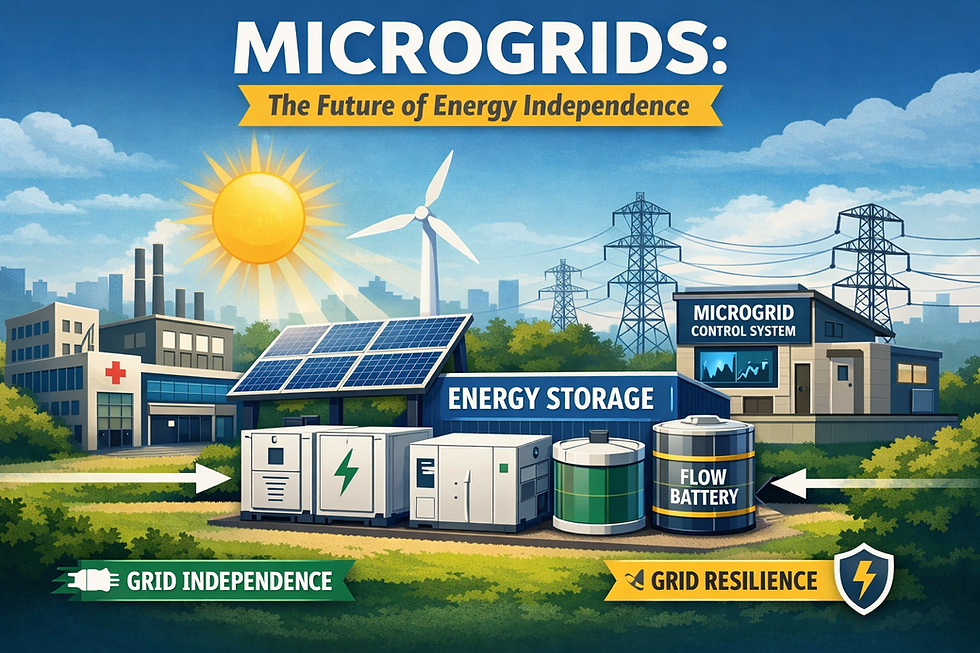
Energy Storage Is the Backbone of Modern Microgrids
At their core, microgrids are designed to operate both connected to the traditional grid and independently when necessary. Achieving that flexibility requires a system capable of balancing generation, demand, and stored energy in real time.
This is where energy storage becomes critical.
While lithium-ion batteries currently dominate the market due to their maturity and falling costs, there is increasing interest in alternative technologies that offer longer operational lifecycles and improved durability.
One of the most discussed emerging solutions is flow batteries. Unlike lithium-ion systems, flow batteries store energy in liquid electrolytes contained in external tanks. This architecture allows them to scale storage capacity more easily and significantly extend cycle life, making them attractive for large commercial and industrial microgrid energy storage applications.
As microgrid projects grow in scale and complexity, the role of storage is evolving from a supplemental feature to a core design component. In many modern microgrids, storage acts as the central hub that enables load balancing, peak shaving, and seamless islanding during grid outages.
Grid Reliability Is Driving Microgrid Adoption
Across the United States, concerns about grid reliability are increasing. Extreme weather events, wildfire-related power shutoffs, aging infrastructure, and rising electricity demand have all highlighted vulnerabilities within centralized grid systems. For businesses that depend on continuous operations, even short outages can result in significant financial losses.
As a result, many organizations are turning to microgrids as a resilience strategy.
A properly designed microgrid allows facilities to isolate themselves from the main grid and continue operating using on-site generation and stored energy. This capability, often referred to as islanding, has become a major selling point for commercial and industrial energy users.
Industries such as manufacturing, healthcare, data centers, and logistics are increasingly viewing microgrids not as experimental technology but as a practical risk management tool. The ability to maintain operations during grid disruptions is quickly shifting microgrids from optional upgrades to essential infrastructure.
The Role of Microgrid Control Systems
As microgrids integrate more energy sources and storage assets, system coordination becomes increasingly complex.
This is where the microgrid control system plays a critical role. A microgrid control system functions as the central intelligence layer that monitors generation, storage levels, and facility demand. Using advanced algorithms, it continuously optimizes how energy flows within the microgrid. These systems must balance several objectives simultaneously:
maintaining power stability
minimizing energy costs
managing battery cycling
coordinating with the broader grid when connected
When grid disruptions occur, the control system also manages the transition to island mode and ensures that critical loads continue receiving power. Advances in microgrid control software are enabling far more sophisticated energy management strategies, allowing facilities to participate in demand response programs, optimize time-of-use pricing, and integrate renewable generation more effectively.
In many ways, the evolution of microgrid control systems is what allows modern microgrids to operate as dynamic energy platforms rather than simple backup power systems.
Policy Support Is Accelerating Deployment
Policy incentives are also playing an important role in expanding microgrid adoption. Federal programs such as the Inflation Reduction Act and other energy policy initiatives continue to provide tax incentives for energy storage systems. These incentives significantly improve the economics of deploying batteries alongside distributed generation.
For many commercial and industrial facilities, these incentives can reduce the upfront cost of microgrid projects and shorten payback periods. Combined with rising electricity costs and growing concerns about grid reliability, these policies are helping move microgrids from demonstration projects to large-scale deployment.
Why Microgrids Are Becoming Essential Infrastructure
The broader energy system is undergoing a fundamental transformation.
Electric grids are becoming more decentralized as renewable energy, storage, and distributed generation technologies expand.
In this environment, microgrids serve as a bridge between centralized utility infrastructure and localized energy systems. By integrating generation, storage, and advanced control systems, microgrids provide a flexible platform that can improve resilience while supporting decarbonization goals. For commercial and industrial energy users, the value proposition is becoming increasingly clear:
greater energy independence
improved reliability during outages
better management of electricity costs
integration of renewable energy resources
As these factors converge, microgrids are moving beyond their historical niche role.
They are becoming a core component of modern energy infrastructure.
The Outlook for Microgrids in 2026
Looking ahead, several trends are likely to accelerate the growth of microgrids.
Energy storage technologies will continue evolving, with flow batteries and other long-duration storage solutions gaining traction for large-scale projects. At the same time, improvements in microgrid control systems will enable more sophisticated energy management and grid interaction.
Most importantly, rising concerns about grid resilience will continue pushing organizations to invest in localized energy solutions. Taken together, these trends suggest that the next phase of energy infrastructure will be defined not just by centralized grids, but by networks of intelligent, distributed microgrids capable of operating independently when necessary.
What was once considered a niche solution is rapidly becoming an essential part of the modern energy landscape.


Comments